
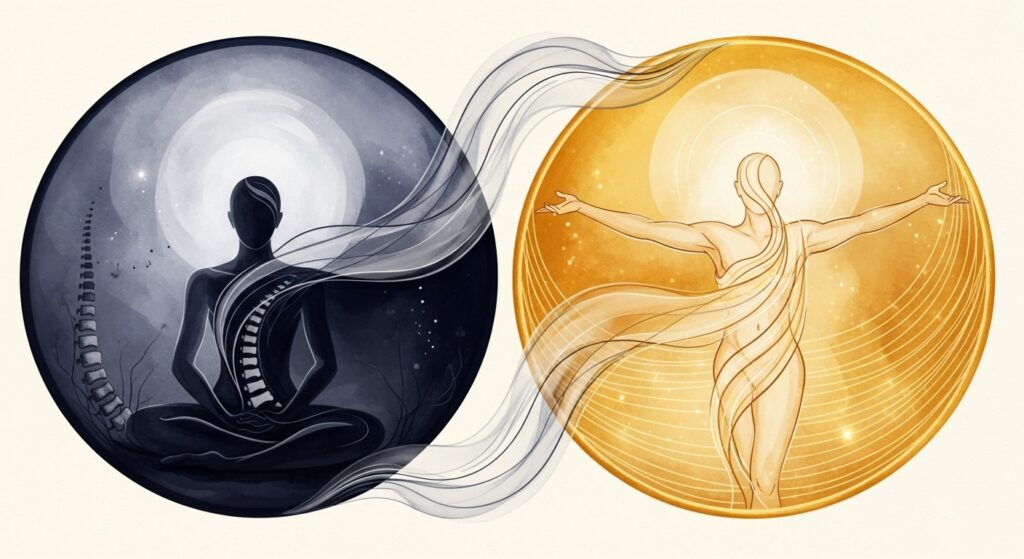
Two Sides of the Same Coin
Inhibition and Direction: Two Sides of the Same Coin
The Dance of Yin and Yang in the Alexander Technique
The ancient Chinese philosophy of Yin and Yang teaches us that opposites are not conflicting, but complementary. They exist in a dynamic relationship, where one cannot exist without the other, and together they create balance. This balance is ever-changing, adapting to the flow of life. In many ways, the Alexander Technique’s core principle of One Skill mirrors this dynamic.
Inhibition and direction are not separate forces, but two sides of the same coin—interdependent, fluid, and mutually reinforcing. In the same way that Yin cannot exist without Yang, inhibition cannot truly function without direction. In fact, the two are so interconnected that when you are inhibiting, you are inherently directing, and when you are directing, you are inhibiting.
Understanding Inhibition: The Yin of the Technique
In the I Ching, Yin is the passive, receptive force. It is the stillness of the night, the moon’s gentle pull, the acceptance of what is. In the Alexander Technique, inhibition mirrors this Yin quality. It’s the act of pausing—of consciously choosing not to react to a habitual movement or response.
Inhibition is not about doing nothing, but rather about creating space. By resisting the compulsion to tighten, brace, or over-control, we allow ourselves to return to a more natural, expansive state. This moment of stillness before movement is where real change begins. Just as Yin is the foundation of all movement in the universe, inhibition is the foundation of coordinated, efficient movement in our body.
Direction: The Yang of the Technique
On the opposite side, Yang is active, dynamic, and expansive. It represents movement, energy, and outward expression. In the Alexander Technique, direction serves as the Yang force—it’s the act of consciously guiding the body in a particular direction. This could be the intention to lengthen the spine, to direct energy up and out of the head, or to align oneself with gravity and space.
Direction is not forceful—it’s a gentle, open invitation to the body to expand. It’s not about pushing or striving, but about creating a path for the body’s natural intelligence to follow. Just as Yang brings the energy of creation and movement into the world, direction offers the body the flow and intention it needs to move with ease and efficiency.
Inhibition and Direction: A Unified Whole
The brilliance of the Alexander Technique lies in the understanding that inhibition and direction work together. They are not opposing forces, but complementary ones. In the same way that the Yang (active) energy of a river is guided and directed by the Yin (receptive) forces of its banks, inhibition and direction guide the flow of our body’s movements.
When we inhibit a habitual response—when we stop the tendency to tense or brace—we free up space for direction to flow in. This process allows the body to expand fully, aligning itself with gravity and the space around it. We no longer fight ourselves to get things “right”; instead, we trust that by allowing our body the space to move freely, it will find its own path.
Inhibiting to Direct: How They Work Hand-in-Hand
When we inhibit, we are not merely stopping ourselves from moving. We are creating a state of readiness, allowing our body to release the habitual patterns that limit its potential. And within that space, direction naturally arises. If we hold tension in our muscles, we restrict movement; if we let go of that tension (inhibition), we create the possibility for fluidity and expansion.
In this way, inhibition isn’t just the absence of tension; it is the presence of space. The absence of contraction allows for the direction to be fully realized—whether it’s a movement, a gesture, or a change in posture. In other words, when we stop “doing” in a forced way, we create the potential to be in a more expansive, dynamic way.
The Subtle Balance: Yin, Yang, and the One Skill
As we practice the Alexander Technique, we cultivate a deep awareness of this subtle balance between inhibition and direction. At any moment, we can pause, check in with our body, and assess how we are holding tension. Then, we can direct our body toward greater length and freedom. But this is not a process of constant striving—it is the natural unfolding of Yin and Yang working together in harmony.
The beauty of the One Skill lies in its simplicity: to inhibit is to allow; to direct is to expand. Together, they form a fluid, adaptable system of movement that is not about getting it right, but about allowing what is most natural to emerge.
A Practice: Inviting the Flow of Inhibition and Direction
Here’s a simple exercise to begin experimenting with the balance between inhibition and direction:
- Pause. Stand or sit comfortably and take a moment to check in with your body. Notice any tension or tightness.
- Inhibit. Without trying to force or correct, simply choose not to react to the habitual tension you’ve noticed. Let it soften.
- Direct. Gently imagine your spine lengthening upward, or your head floating lightly on top of your spine. Direct your energy upward without forcing.
- Rest. Let your body rest in this state of expansion, and notice how it feels to allow rather than control.
This practice of alternating between inhibition and direction helps to cultivate a sense of balance, fluidity, and freedom in your body. Just like the interplay of Yin and Yang, you’ll find that inhibition and direction are always shifting and adapting, but together, they create a harmonious flow that guides your movements and your life.